


Inflation Outlook - October 2026
Summary
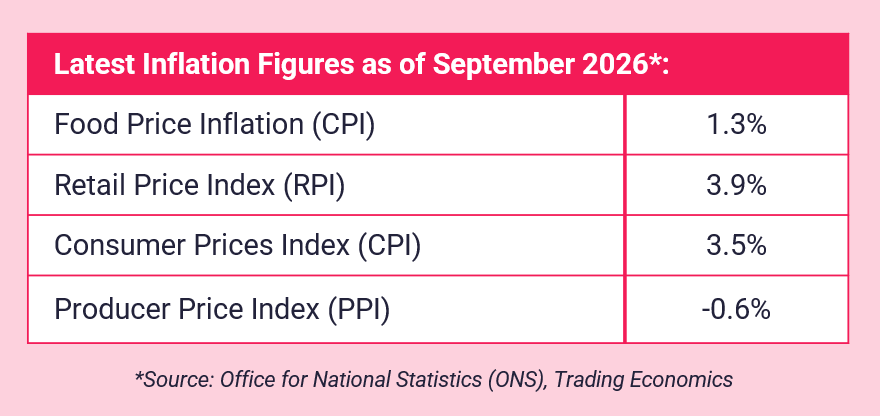
• The Consumer Prices Index (CPI) increased to 3.5% in September, up from 3.1% in August, while food and non-alcoholic beverage inflation remained stable at 1.3% YoY.
• Although the annual rate of inflation for food and non-alcoholic beverage prices has remained the same for the last three months, organisations like the Food and Drink Federation expect food inflation to arrive later and persist for longer. This is partly because pressure on household budgets, competition and retailer resistance to price increases have limited manufacturers' ability to pass on higher costs.
• The Retail Price Index (RPI) is now 3.9% vs 3.4% last month.
• Irrespective of an increase not seen on the Food CPI month on month, Food inflation remains and cost pressure continue to impact our supply base.
Fish and Seafood
Cod & Haddock: Cod prices continue to increase as demand from frozen producers increases and availability of larger fish remains limited due to quota constraints. This is in turn placing pressure on fillet, portion and supreme pricing, which are dependent on the larger fish sizes. Haddock pricing remains mixed by size but firm over the coming winter months. This is a continued increases in fuel and logistics costs are expected to keep the whitefish market firm over the winter period.
Salmon & Trout: Salmon prices have begun their typical seasonal rise as smokehouses increase production and build stock for festive demand. In addition, the most recent increases in fresh Chalk stream trout costs are now flowing through to smoked and cured products. Market expectations are for trout pricing to remain relatively stable, while salmon will continue to see upward pricing increases through the festive period.
Grocery - Commodities
Rapeseed Oil: We are entering into an inflationary period for rapeseed oil as energy markets continued to remain highly elevated due to the ongoing Middle East conflict. Additionally, increased biofuel mandates in Germany & US is driving vegetable oil demand. Looking ahead, the predicted El Niño may adversely impact oil production & yields globally further supporting rapeseed oil markets.
Canned Tomatoes: Strong tomato planting in Italy and Greece resulting in raw material price decreases. FY27 pricing nearly flat compared to last years levels due to raw material decreases and strong strategic vendor relationships.
Sugar: FY27 contract will provide price relief due to deflation in raw material market compared to prior contract period. Looking ahead, sugar markets are expecting significant inflation due to El Niño. As a result, we have proactively extended our contract longer than usual to mitigate risk to the business.
Canned Tuna: Tuna market is highly inflationary as the El Niño is causing fish to swim deeper and outside of typical waters resulting in longer, more challenging fishing conditions. Additionally, pole & line boats have been decreasing each season creating even more limited supply in an already challenged market. Finally, these longer fishing trips are exacerbated by inflated energy prices.
Dairy
Farmgate pricing continues to rise with a sharper uptick in September, while UK milk supplies slowly recover as milk yields improve with lowering temperatures. Suppliers in our network anticipate lower winter forages may put further pressure on feed stock levels, subsequently increasing costs later this year.
Farmgate pricing rose through September, while October announcements are mixed. Some of the largest players are holding steady while others continue to implement increases.
Butter pricing rose in the UK but a global surplus in fresh & frozen weighs on further increases. However, there is likely to be an impact on production & supply as feed stocks reduce toward the end of the year.
After a price spike in September, cream pricing shows signs of stabilising in coming months from subdued demand and yield recovery. Although, as we head into the Christmas period, increased seasonal demand may change this outlook.
Skimmed milk powder prices continued to rise due to strong export demand and a mass market trend for protein rich foods, which is tightening supply. Margins are also tightening because the production process for SMP is energy intensive, so it is vulnerable to fuel price swings.
UK cheddar pricing is consistently rising, the market reports tight supply after key players leaving the market, margin concerns and solid demand.
Market intelligence suggests that manufacturers have responded to increasing demand for mozzarella by increasing productivity, keeping demand levels supported and pricing stable. There are reports of further capacity expansion, if supply exceeds demand, then prices may decline but this is not verified.
Sentiment in the egg market is firm, with rising demand for UK British Lion eggs, due to Salmonella outbreaks in the import market. As we head into Avian Influenza season, disease outbreaks could threaten supply. We're currently reviewing our egg category to build on the resilience in our supply chain.
Bakery
The UK bakery commodity outlook remains broadly unstable heading into the next quarter. Across Europe, Wheat price looks to be increasing however the overall outlook is relatively manageable due to stocks. Dairy, sugar, Cocoa and Energy remain the most likely sources of inflationary pressure for UK bakery suppliers in the next quarter.
Wheat & Flour: Markets remain relatively unstable, weather and geopolitical risks continue to create some uncertainty. UK wheat has seen some inflation over the last quarter due to drought and harvests being brought forward however as this affects 11% of our total range and we are led to believe it was a good harvest, we expect to see manageable impact over the next quarter.
Fruit and Vegetables
Overview: Seasonal transition & Effects of Drought
We are currently in the main transition period where crops are moving from UK sourced to Holland and Spanish supply. This therefore means there will be a few weeks with tight availability on some lines as the non-UK season gets going. In addition to this we are seeing the effect of the summer weather and drought on crop that would usually be plentiful at this time of year. This is causing smaller size crops, smaller yields leading to reduced availability, and in some cases reduced shelf life.
Tomatoes: The market remains tight for tomatoes as we reach the end of the Northern Europe and IOW crop. Beef, Plum and Cherry tomatoes will have the most pressure as there is reduced Dutch and Moroccan volumes. Improvements should be seen by the end of the month when the winter crop comes through to stabilise the supply.
Lettuce: The intense heat and drought over the summer, has caused the perfect conditions for pests in every growing region. Pests damage the crops by eating vital nutrients. This has been seen in particular the lettuce crop, with what has been described as the worst outbreak in a generation. There have been high levels of the lettuce aphid which causes serious challenges for growers and is affecting the yield of the crop. Growers are harvesting early to reduce pest pressure however this means some lettuce will not reach its target weight.
Onions + Potatoes: The UK potato crop is facing significant challenges following prolonged periods of hot and dry weather. Yields are currently estimated to be around 30% below normal weight, with pressure on larger baking grades, particularly 40s and 50s. This is due to tuber sizing being severely affected by the lack of water during key growing periods, resulting in reduced availability of larger potatoes. Similar weather-related challenges are affecting major European growing regions, limiting the availability of imports that would normally help support the UK market. This is expected to continue from October through to July next year, with prices likely to remain elevated as domestic and European supplies tighten. We will also see this across onions which have also been affected by the lack of water due to the drought.
Brassica: The growing conditions are starting to improve; however, most Brassica will be smaller than usual as the colder nights make it harder for the crop to grow. Pest pressure is high on this category, and we expect to see tight availability through the winter particularly on cauliflower and cabbage.
Seasonal spotlight: Squash. Although most squash will be smaller than usual due to the heat we saw over the summer there is good availability on smaller sizes. They should be sweet and are ideal for roasting.
Meat
HEADLINE: Beef is moving higher again as Christmas buying competes for limited cattle. Fresh turkey is also expected to increase through November and December, with seasonal demand and renewed avian influenza risk increasing price and availability exposure.
Beef: Beef pricing is moving upwards again. GB all-prime cattle prices have almost reached 650p/kg in October, while prime cattle throughput remained below the same week last year. AHDB now expects 2026 beef production to be broadly stable at 904,000 tonnes, heavier carcass weights are offsetting lower throughputs, but the underlying cattle pipeline remains tight. Christmas procurement is increasing competition for available animals, and this is beginning to translate into higher foodservice pricing. The strongest exposure remains across mince, burgers, trim, diced beef and other forequarter-led lines, where demand for value products competes for constrained raw material.
Beef Outlook: Further inflation is likely through November and into the Christmas period, particularly for UK-sourced and tightly specified lines. Premium cuts may remain more demand-sensitive, but this is unlikely to remove pressure from manufacturing beef and value cuts.
Turkey: Turkey is entering its most inflationary seasonal window. Fresh supply is exposed to the normal build in Christmas demand, while suppliers are also reporting higher rearing, processing, labour and distribution costs. The disease backdrop has worsened since last month: Great Britain lost HPAI-free status following the first case of the 2026/27 season in Scotland on 2 October, followed by a confirmed commercial poultry case in Northumberland on 19 October. These outbreaks do not yet establish a national shortage, but they increase the risk of movement restrictions, loss of birds and tighter fresh availability during the critical festive period
Turkey Outlook: Upward pressure on fresh turkey is expected as Christmas approaches. Previously frozen or frozen lines should remain more predictable where price and volume has already been secured. Risk is greatest for fresh, free-range, organic, Halal and tightly specified products with limited alternative capacity.
Lamb: Lamb remains expensive and structurally tight. The September quarterly review identified lower domestic production, a contracting breeding flock and dependence on imports as the main constraints. October AHDB data continued to show limited sheep availability, with the deadweight new-season lamb SQQ at 719p/kg in October, 58p/kg above the same week in 2025.
Lamb Outlook: Pricing is likely to remain elevated through November. Country of origin, assurance and cut specification will continue to determine the level of pressure. Review secondary cuts, mince and diced formats, and retain origin flexibility where customer requirements permit.
Recommendation: With food commodity inflation placing further pressure on client menus, the priority should be to manage exposure while preserving choice, quality and value. For beef-led dishes, clients should review portion sizes, cut selection and recipe design, including greater use of secondary cuts, blended products or alternative proteins where this supports the menu proposition. Festive turkey, purchase frozen where suitable to improve price certainty and protect availability. Pork and chicken can provide more cost-effective alternatives where appropriate.
UK Key Market Movers
| Category | Percentage change over 12 months |
| Milk, cheese and eggs | 0.1% |
| Oils and fats | -2.4% |
| Breads and cereals | 1.5% |
| Vegetables | 2.5% |
| Meat | -0.1% |
| Sugar, Jam, Syrups, Chocolate, and confectionery | 0.2% |
| Fish | 8.3% |
| Fruit | 1.9% |
Search