
Inflation outlook and foodservice market update - February 2026

25 February, 2026

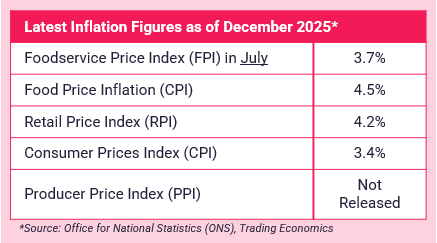
The Consumer Prices Index (CPI) rose by 3.4% in the 12 months to December 2025 up from 3.2% in the 12 months to November. Food and non-alcoholic beverages prices rose by 4.5% in the 12 months to December 2025, up from 4.2% in the 12 months to November. On a monthly basis, food and non-alcoholic beverages prices rose by 0.8% in December 2025, compared with a rise of 0.5% a year ago.
Market movers:

FISH & SEAFOOD

Salmon – Salmon prices in January have reached a new high. It reflects the decrease in harvesting over the Christmas period in Norway. The whole supply system re-boots as lorries and hauliers return to their normal schedules. Prices should ease for March.

Whitefish – Fresh cod prices have risen. With less landings over Christmas there are fewer overall fish to grade. Certain sizes are therefore scarcer depending on the catch. We expect white fish prices to continue to rise both for fresh (Icelandic) and frozen (Norwegian).

As forecast last month, haddock prices have risen. With limited cod availability, buyers are increasingly turning to haddock, adding further upward pressure. Frozen stocks of both cod and haddock are seeing significant price increases, which are already becoming evident and are expected to continue into next quarter. Supply remains constrained due to quota reductions, particularly in the Barents Sea, alongside the continued embargo on Russian fish. Cod landings from the Barents Sea are down 50% compared to 2023 levels.

FRUIT & VEG

Weather – It’s predicted to be a difficult few weeks due to the ongoing cold, overcast weather in the main European and North African growing regions and successive storms affecting both growth, quality and availability.

Transport: Ports – Deteriorating weather conditions have caused delays to some shipping, causing arrival dates to be pushed back.

Road & Rail – Weather-related problems and increased border checks are causing some delays for produce coming from Europe and Morocco. We are also seeing greatly reduced ferry services as high winds and rough seas make transportation more challenging.

Spinach – There will be some yellow cotyledons present. These are the small leaves beneath the main plant, and due to the cold conditions, they have grown at the same rate as the main leaf, meaning they are being picked up at harvest. The main leaf quality itself is good.

Courgettes – Courgettesare between growing cycles, resulting in lower market availability.

Aubergines Auberginesremain under some pressure as the continued poor conditions in Spain are not allowing fruit to mature as usual, which means that growers need to pick more immature produce.

Root veg – Persistent rain, which is around 50% higher than a standard January, has led to products becoming saturated. This is having a major impact on root vegetables, particularly carrots and parsnips. The life of the product may be reduced, and suppliers have been advised to keep the products in chilled conditions.

Brassicas – The heavy rainfall is also impacting brassica crops. This is particularly affecting cauliflower, where we are seeing some quality issues. Savoy cabbage has been affected by the recent frosts, requiring the removal of additional outer leaves and resulting in reduced finished weights.

Easy peelers – Heavy rainfall in Spain and Morocco has made harvesting difficult. Continued poor weather, combined with wider transport issues including cancelled ferries, is increasing pressure on supply.

Lettuce Wet conditions are severely impacting crops, with iceberg lettuce particularly affected.

Peppers – Yellow and orange peppers are particularly affected as the current poor weather is slowing their maturation.

MEAT

Beef After a record year of inflation, beef prices are stabilising. Trim products remain steady as consumers favour cheaper cuts, sustaining demand. Low cattle availability still poses an inflation risk, though pressures eased slightly in January and are expected to continue through 2026. Surplus stock from festive over-forecasting has also supported short-term price stability.

Chicken Avian Influenza cases are affecting availability in the UK and EU. Housing orders, increased biosecurity measures and flock culls have impacted availability. However, pricing has held up better than initially expected, with lower supply availability helping sustain prices during the quieter months of consumption. We anticipate inflation risks as consumption increases again through February and into March.

Lamb – Pricing seasonality has been replaced by non-traditional patterns, driven majorly by southern hemisphere availability. Flock numbers in the UK are down and at their lowest levels since records began. Supply will be very tight for Q1 to Q3 of 2026. Poor weather conditions and reduced production throughout has impacted availability so far this year. We anticipate pricing to be challenging throughout this period.

Pork – Pork has been stable throughout 2025. Driven mainly by producers’ improving their carcass yields and by Chinese tariffs limiting exports. Provided these factors remain in play, pork pricing and availability should continue to remain stable with potential for decreases. There are some concerns in Spain around African swine fever cases being reported, however this has been contained so far.

DAIRY

There are some early signs of the dairy market beginning to stabilise; there is an anticipation prices may soften on skimmed milk powder and cheddar. However, other input costs remain a factor.

Milk production remains high, and there are ongoing concerns about potential milk dumping as the spring flush approaches, with processors unlikely to be able to handle the increased volumes.

January saw more cattle coming to market, though it is not yet clear whether this reflects dairy farmers reducing herd sizes to take advantage of strong beef prices and limit milk production.

The longer-term outlook of dairy farming remains challenging, with many farmers facing squeezed margins due to lower milk prices alongside ongoing input cost pressures.

BAKERY

We’ve seen early indications that certain commodities are beginning to track downward. Our current insights are mainly across the following areas:

Cocoa (West Africa & Belgium): Cocoa prices have fallen by almost half since the start of 2025, now settling at just over £4,000 per tonne. However, this is still some way off a full recovery to 2023/24 levels. In contrast, Belgian chocolate pricing has yet to show deflation. Year-on-year, we are still seeing an approximate 11% impact on the business. British Baker has also reported that some suppliers are turning to ingredient additions as a means of offsetting the cost increases of chocolate.

Wheat: Reports suggest that wheat and cereal prices are beginning to ease. Crop challenges throughout 2024 and early 2025 drove significant inflation across products containing these ingredients. Notably, some suppliers have already introduced deflation in early 2026 within the bread sub-category, and we hope to see this trend become more consistent going forward.

UK KEY MARKET MOVERS (CPI)

The Consumer Prices Index (CPI) is a key measure of inflation in the UK. Movements in CPI give a high-level overview of the key categories experiencing inflation. Below is a monthly snapshot of the top food commodity price inflation movements impacting the UK. The data is from the Office for National Statistics (ONS).

Percentage change over 12 months:

  • Milk, cheese and eggs: 2.5%
  • Oils and fats: -1.6%
  • Breads & cereals: 4%
  • Vegetables: 2.4%
  • Meat: 6.9%
  • Sugar, jam, syrups, chocolate and confectionery: 10.2%
  • Fish: 1.1%
  • Fruit: 1.8%

FINAL WORD

Regency continue to proactively mitigate availability issues and supply risk, putting solutions in place to reduce impact, such as product switches and recipe re-engineering.

When analysing the effects that inflation has on your businesses purchasing, it's important to understand that inflation affects not only the price of goods, but also the quality and availability - this is something that our team of procurement experts can assess in detail, to ensure our members are always achieving the best outcomes in all areas.

Equally, we fully understand the challenges presented by the increase in Employer National Insurance Contributions and National Living Wage, along with reduction in business rates relief and increased water bills. Our team of experts are working closer than ever with our members to reduce their purchasing costs in attempt to lessen the impact of rising costs in other areas of the business.

To find out more about ways in which we can help save your business time and money, get in touch.

Sources: Foodbuy, Fairfax Meadow, Birtwistles.

Share this article:

Stay connected

Enter your email address to be kept up to date with latest news, company developments and market insights. You can unsubscribe at any time.
View our Privacy Policy.